Deployable 480V infrastructure

Infrastructure at the speed of need.

MEVPAC® designs and deploys containerized, field-deployable 480V electrical service platforms for EV charging and emergency power — built to close the gap between real need and permanent buildout.

480V
3-phase service, all platforms
3
Platform configurations
KY
Crestwood, Kentucky HQ
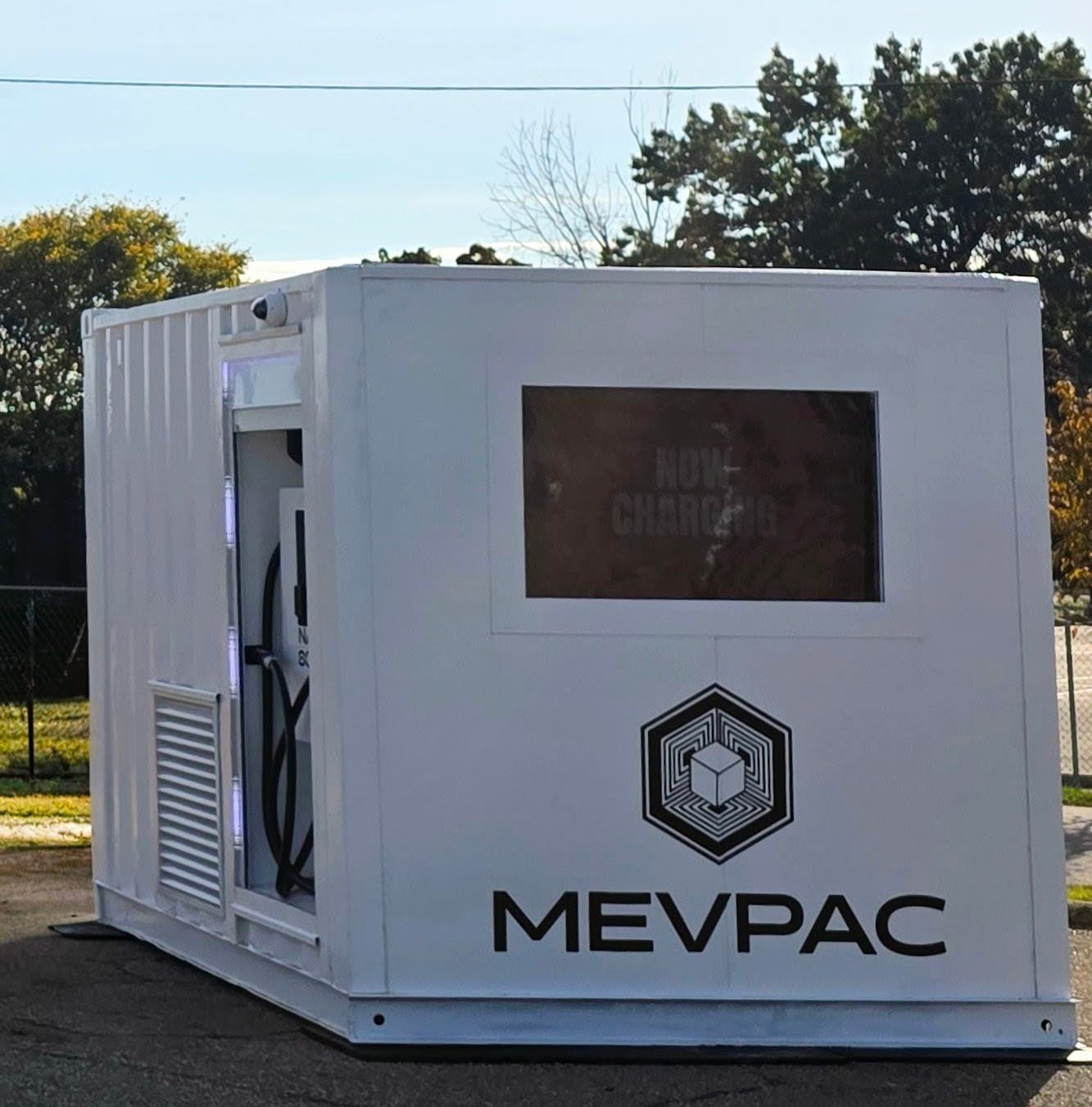
Deployed MEVPAC MP400 unit in the field
Actual deployed unit — MP400, field photo
MEVPAC is deployable infrastructure first and hosted charging second. The charger is a function inside the platform — the platform is the product.

Permanent charging infrastructure takes years: utility upgrades, trenching, civil packages, capital approval. MEVPAC's containerized platforms step into that timing gap, bringing rated 480V service and EV charging to a site before the permanent build is ready — and relocating when it is.

The platform family

Three configurations, one architecture

Every MEVPAC platform shares the same PACTAP interface and containerized distribution design. Scale is the only variable.

MP400 field-deployed unit Field photo

MP400

10-ft container · entry platform
  • Service400A / 480V 3-phase
  • DC fast charge ports4
  • Level 2 ports1
  • NEVI-eligibleNo
MP800 concept rendering Concept render

MP800

20-ft container · NEVI-eligible
  • Service800A / 480V 3-phase
  • DC fast charge ports2
  • Level 2 ports4
  • NEVI-eligibleYes
MP1200 concept rendering Concept render

MP1200

40-ft container · builds on MP800
  • Service1200A / 480V 3-phase
  • DC fast charge ports3
  • Level 2 portsup to 5
  • NEVI-eligibleYes
Onboard systems

Built-in, on every platform

Every MEVPAC® platform ships with the same onboard systems — the equipment that keeps a deployment monitored, connected, and safe to operate in the field.

C

Dual-tier charging

DC fast charging and Level 2 charging on every platform, sized to NEVI port-power requirements.

M

Real-time monitoring

Onboard metering reports real-time power draw, energy consumption, power factor, and harmonics from the main panel.

R

Remote management

OCPP 2.0.1-compatible remote management and automatic fault recovery, built for third-party network operation.

N

Redundant connectivity

Satellite uplink as the primary connection, with automatic cellular failover to protect uptime reporting.

B

Battery-backed controls

An onboard UPS bridges power to controls, connectivity, and the payment terminal during a source transfer.

S

Onboard surveillance

An exterior-mounted security camera provides continuous, remotely monitored coverage of the deployment site.

L

Locked-out safety interlocks

Lockable disconnects, a weatherproof emergency stop, and arc-flash labeling on every panel per NFPA 70E.

P

Public payment & Wi-Fi

An integrated point-of-sale interface and public Wi-Fi access support monetized, public-facing charging.

The core differentiator

PACTAP: prepared access before permanent commitment

PACTAP is the interface architecture that separates permanent utility service from the MEVPAC® container platform — the structural idea that makes rapid deployment and redeployment possible.

Patent pending
  • The utility side stays a real-property fixture, permitted once at the host site.
  • The container side is personal property — mobile, redeployable, and a physical asset.
  • Physical disconnection at the PACTAP boundary, combined with a locked-open main breaker, does the isolation work — no automatic transfer switch required inside the container.
  • The architecture is engineered toward FEMA P-1019 anti-backfeed principles and NFPA 70E (2024) arc-flash labeling standards.
Ahead of PACTAP — utility side Real property. Permanent fixture. Host-site owned.
The PACTAP interface UL-listed interface connectors. The physical separation point.
Beyond PACTAP — container side Personal property. Mobile. End-user owned and redeployable.
Fleet architecture

Standardized by design, not by exception.

Scalable. Repeatable.

MP800 and MP1200 platforms share a single 480V main distribution panelboard architecture, identical PACTAP interface specifications, and NEC-compliant conductors and OCPD schedules across every deployment. Standardization is what makes rapid redeployment and consistent inspection outcomes possible at scale — the same interface passes inspection at one crossing as at the next.

Network coverage

One container. Many locations.

Because the PACTAP interface lives at the host site — a permitted, in-ground connection pad — rather than on the container itself, a single MEVPAC® platform can rotate across multiple pre-positioned locations as need shifts, moving to wherever population density, seasonal demand, or timing calls for it next, without a new utility buildout at every stop.

That same network of pre-positioned pad locations can also be built into a broader emergency management strategy — connection points already in the ground, permitted, and ready before a disaster hits, so a platform can roll onto the nearest pad the moment it's needed rather than waiting on a new utility connection to be built under pressure.

Auxiliary power access

Additional power access points, beyond charging.

Every platform includes dedicated auxiliary connection points separate from the EV charging load — built to bring power in from an alternate source or send it out to a command center, shelter, or other critical facility need. Each port carries its own dedicated overcurrent protection, weatherproof housing, and voltage identification, and the PACTAP lockout ensures only one source is ever connected to the platform at a time.

Power input

480V generator / prime power

400A–800A
3-phase, 4-wire · MP800 / MP1200

Accepts an alternate 480V source into the platform's main panel when the primary utility connection isn't available.

Power export

208Y/120V facility export

Up to 200A
3-phase, 4-wire · per port

Exports power out to a command center, shelter, or other critical facility load drawing standard 208Y/120V service.

Power export

120/240V single-phase export

Up to 100A
Single-phase

Covers lighter single-phase loads and equipment that doesn't require a full three-phase connection.

Proveout before permanent placement

Every deployment is also a dataset.

A MEVPAC placement isn't just interim charging — it's a measurement device. Because the same standardized platform can be placed, monitored, and moved, it generates real usage evidence at a site before anyone commits capital to a permanent build there.

PHASE 01

Deploy & baseline

Place the unit and establish real use: uptime, operational friction, user behavior, and host behavior — the first layer of decision-grade evidence.

PHASE 02

Review & refine

Compare zones and host types against actual conditions, not assumptions. Siting and access logic get corrected based on what the data shows.

PHASE 03

Scale, reposition, or stop

Strong placements earn the next move — including the case for permanent, fixed infrastructure at that site. Weak placements aren't protected for optics.

Uptime Session count Session duration Repeat-user rate Peak-use windows Downtime cause codes Service response interval

MEVPAC is not the denial of permanent infrastructure. It's the front-end correction to a slow permanent path — proof gathered on-site, before the capital decision, instead of a forecast made without it.

Markets

Markets we serve

The same infrastructure timing gap shows up differently across sectors. Here's how MEVPAC® applies in each one — and how far along each lane is today.

M

Municipal & fleet

Cities building EV and municipal-fleet infrastructure incrementally over a 5–10 year horizon, without committing capital to a rigid, permanent build on day one. Supports civic-core public charging alongside interdepartmental fleet use.

Active deployment — Louisville, KY
A

Regional airports

Landside charging and ground-support-equipment electrification that arrives ahead of long-cycle permanent layout decisions and construction — letting an airport authority electrify at its own pace while capturing public charging revenue from day one.

In discussion
R

Rural & corridor

Rated charging capacity for underserved highway corridors, river crossings, and tourism or recreation destinations where fixed build-out is slow to reach — filling corridor gaps without waiting for a full permanent network.

Developmental
H

Multifamily & residential

A shared, centralized charging hub for apartment and planned-community parking fields where unit-specific charging isn't practical — placed as a pilot amenity first, then expanded as resident usage data clarifies real demand.

Illustrative fit — not yet a completed deployment
V

Events, venues & temporary power

Charging and auxiliary power for festivals, sporting events, and temporary exhibitions — deployed ahead of an event and redeployed after, turning what would otherwise be idle capacity into an on-site amenity for promoters and venue operators.

Developmental
D

Emergency & disaster response

Architecture engineered toward FEMA P-1019 anti-backfeed principles and USACE ESF-3 tier requirements, with auxiliary generator input built into the PACTAP interface for deployable power in disaster-response settings.

Developmental
Community integration

More than infrastructure. Part of the community.

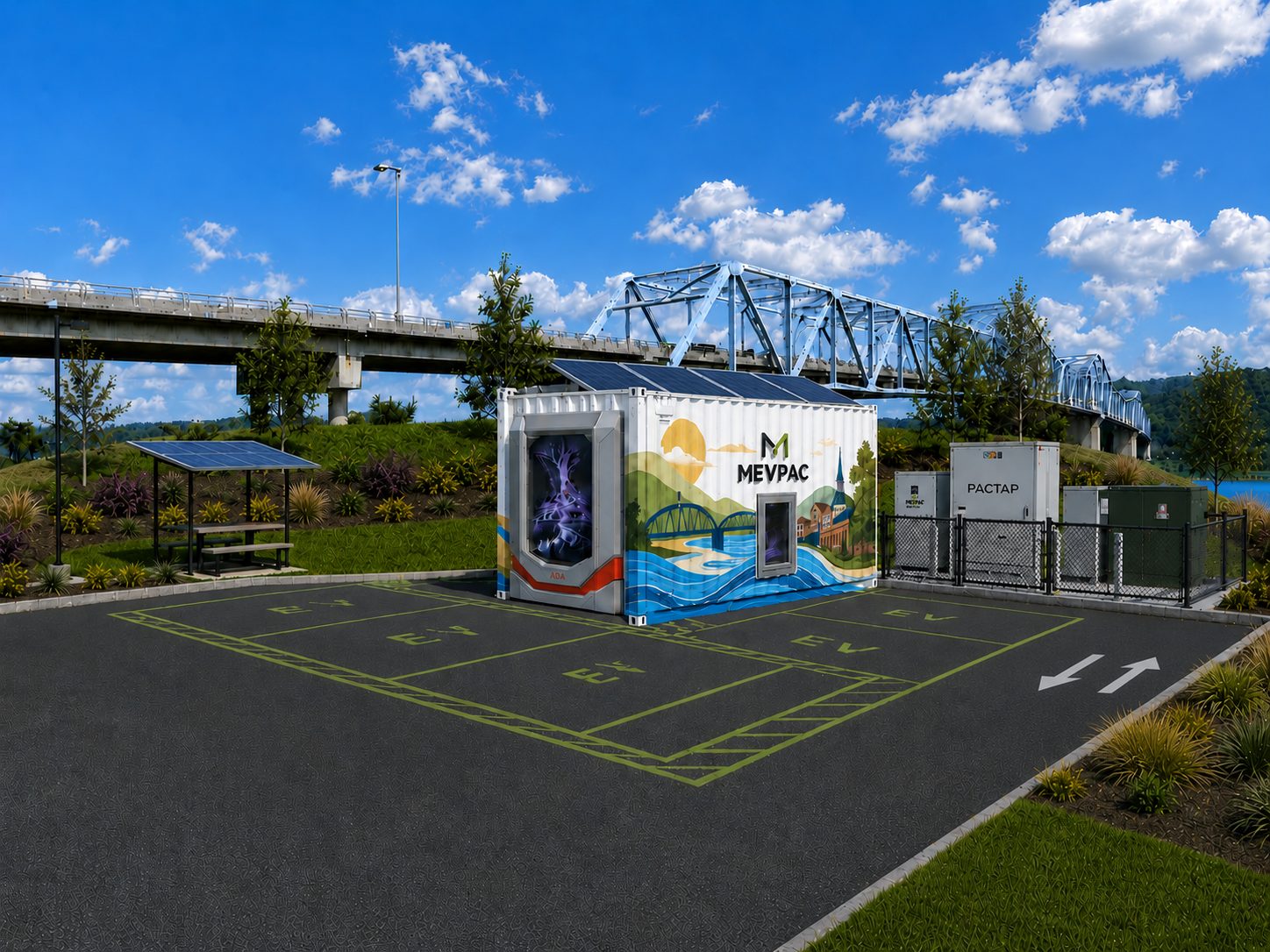
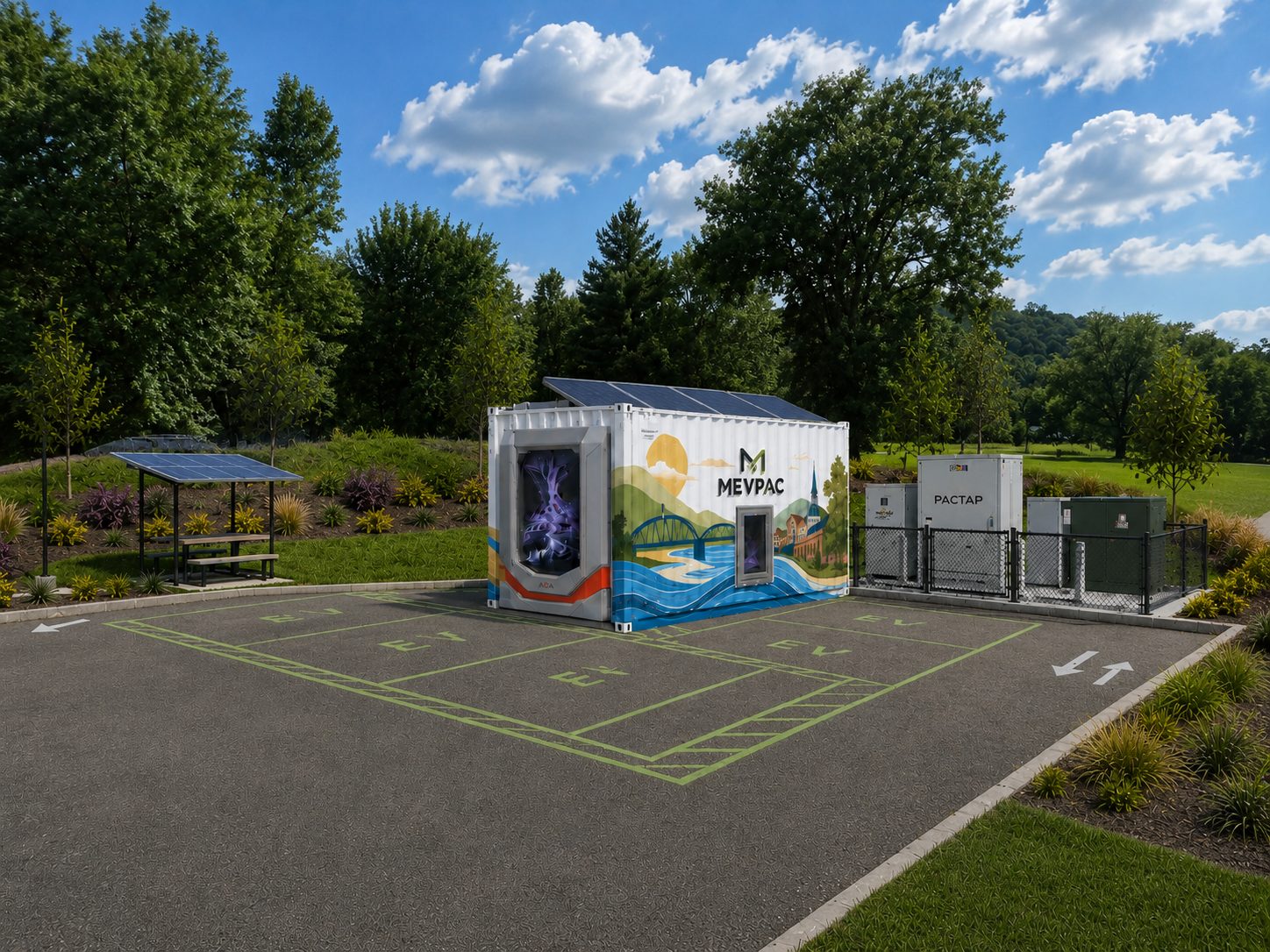
A MEVPAC® platform doesn't have to look like it was dropped into a parking lot from somewhere else. The container's flat exterior panels are built to take a full wrap — a mural reflecting the waterway, skyline, landmark, or local character of the place it's actually deployed.

A host site in a river town can look like a river town. A host site downtown can look like downtown. The platform stays functionally identical everywhere — what changes is the face it shows the community hosting it.

Concept rendering of a MEVPAC unit with a community-themed exterior mural
Concept rendering — illustrative mural treatment
Press & recognition

In the media

Coverage of MEVPAC®, the platform, and the team behind it.

The MEVPAC mascot, a neon cowboy robot holding a charging cable lasso
Who's behind it

Built by people who've done the work

Charlie Waugh

Co-Founder & CEO

Inventor and creator of the MEVPAC® platform. EVITP certified with nearly three decades of electrical experience and an IBEW Local 369 member. An Oldham County, Kentucky native.

Jason Neal

Co-Founder

Handles economic development and outreach for MEVPAC. An Oldham County, Kentucky native.

Also serves as Industrial Base Integration Manager, Advanced Manufacturing at YBI (Youngstown Business Incubator), with a background in economic development that's helped create more than 5,000 jobs and secure more than $2 billion in capital investment.

Why this exists: Charlie Waugh's firsthand experience during Hurricane Irma and Hurricane Maria disaster response — working alongside the U.S. Army Corps of Engineers' 249th Engineer Battalion — directly informed MEVPAC's anti-backfeed and rapid-deployment design principles and the absolute need for portable power access during long-term and widespread outages.

Get in touch

Let's talk infrastructure

Company MEVPAC Enterprises Inc.
Address 2610 Povey Lane, Crestwood, KY 40014
Phone 502-751-4520
Contact Charlie Waugh, Co-Founder & CEO — Jason Neal, Co-Founder